
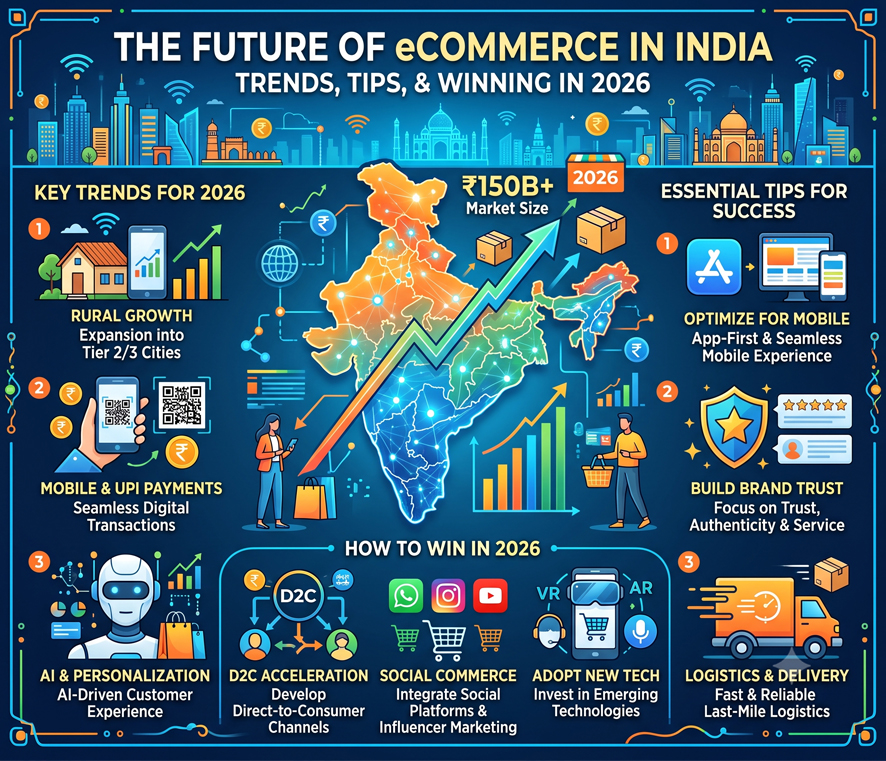
The Future of eCommerce Business in India: Trends, Tips, and How to Win in 2026 & Beyond
Discover the future of ecommerce in India for 2026. A complete guide on trends, web development, SEO, and starting your successful online business today.
Have you noticed how drastically shopping has changed in just the last few years? Not long ago, waiting five to seven days for an online package was perfectly normal. Today, if our groceries take more than ten minutes to arrive, we start checking our phones anxiously. This massive shift in consumer expectations tells us one clear thing: the future of ecommerce in India is moving at breakneck speed.
We are currently looking at an industry that is transforming the way people buy and sell across the nation. By 2026, the Indian ecommerce market is expected to sit at a massive value of around $159 billion, and it is projected to more than double in the coming years. From the busy streets of Kolkata to remote towns in tier-3 cities, internet access and digital payments have turned almost everyone into a potential online shopper.
If you are a business owner, an entrepreneur, or someone just thinking about selling online, you are sitting on a goldmine of opportunity. But it is no longer just about setting up a basic website and waiting for customers to show up. It is about speed, smooth mobile apps, smart marketing, and giving the customer an experience they cannot get anywhere else.
Whether you want to find an ecommerce website development company in Kolkata to build your local brand, or you are looking for nationwide strategies to capture the entire Indian market, you need a plan. This guide is going to walk you through exactly what is happening in the industry right now, the biggest trends to watch out for, how to get your store built properly, and how to bring in a flood of ready-to-buy customers.
1. The Biggest Shifts: Ecommerce Business Trends India 2026
To win in the online marketplace, you have to know where the market is going. The year 2026 is seeing some incredible changes that favor both small business owners and large brands. Here is what you need to know about the current ecommerce business trends India 2026.
The Quick Commerce Explosion
Remember when getting something delivered the same day felt like magic? Now, “quick commerce” has completely taken over. Services like Zepto, Blinkit, and Swiggy Instamart are delivering everything from daily groceries to electronics in under 15 minutes. In fact, the quick commerce market is expected to grow aggressively, reaching billions in value very rapidly. What does this mean for you? Even if you do not promise 10-minute delivery, the overall expectation for speed is higher than ever. Your website needs to load instantly, your checkout process must be flawless, and your shipping needs to be as fast as humanly possible.
The Rise of ONDC
If you are a small business owner worried about competing with giant platforms, you should know about ONDC (Open Network for Digital Commerce). Backed by the government, this initiative allows small retailers to list their products across multiple platforms without paying massive commission fees to a single giant marketplace. It essentially levels the playing field. Even a local shop in Kolkata can now show up in buyer searches right alongside huge, established national brands.
Social Commerce and Video Shopping
People are no longer just browsing websites; they are buying directly from Instagram Reels, YouTube Shorts, and WhatsApp. Social commerce allows a customer to see a video of a product, tap a link, and buy it without ever leaving the app. If you are not integrating your store with social media, you are leaving money on the table.
Artificial Intelligence Personalization
AI is no longer just a buzzword; it is a very real tool that helps sell more products. Imagine a customer walking into a physical store where the salesperson instantly knows exactly what colors they like, what size they wear, and what their budget is. That is what AI does for your website. It tracks what users click on and suggests products they are highly likely to buy. This kind of personalization makes people feel understood and drastically increases sales.
2. Why Now is the Perfect Time to Start an Ecommerce Business in India
If you have been waiting for a sign to start ecommerce business in India, this is it. The infrastructure is better than it has ever been.
The UPI Revolution
The widespread adoption of UPI (Unified Payments Interface) has completely changed the game. A few years ago, people were hesitant to put their credit card details online. Today, scanning a QR code or tapping a UPI link is second nature. This seamless, secure, and instant payment method has built immense trust among consumers. It removes the friction from buying. When payment is easy, people buy more often.
The D2C Boom
We are seeing a massive surge in D2C ecommerce website development. D2C stands for Direct-to-Consumer. Instead of selling products to a distributor, who sells to a retailer, who then sells to the customer, brands are building their own websites and selling directly to the public. This allows you to keep all the profit margins, control your brand image, and build a direct relationship with your buyers.
B2B Online Sales are Catching Up
Ecommerce is not just for selling clothes or gadgets to everyday consumers. B2B ecommerce solutions India are growing rapidly. Wholesalers, manufacturers, and distributors are realizing that business buyers also want the convenience of ordering online. If you run a wholesale business, setting up a specialized B2B portal where your clients can log in, see their custom pricing, and place bulk orders is a massive advantage over competitors still using phone calls and paper catalogs.
3. Building Your Digital Storefront: Website and App Strategies
Your website or app is your digital storefront. Just like a physical shop needs a good layout, bright lighting, and an attractive display, your online store needs to be fast, beautiful, and easy to use.
Choosing the Right Platform
One of the first things an ecommerce business consultant Kolkata will tell you is to pick the right platform for your specific needs. You have a few main options:
- Shopify: If you want a store up and running quickly with reliable hosting and a huge library of add-on features, you might want to look for a Shopify development company Kolkata. Shopify is incredibly user-friendly and handles large amounts of traffic very well.
- WooCommerce: If you already have a WordPress website or you want complete control over every single file and piece of data, WooCommerce is a great choice. Finding a skilled WooCommerce developer Kolkata is relatively easy, and it is a very cost-effective way to start.
- Magento: For massive stores with thousands of products and complex business rules, Magento is a powerhouse. It is heavier and requires more technical skill, which is why hiring a specialized Magento development company India is highly recommended if you are going this route.
Custom Web Development vs. Pre-built Themes
A pre-built theme is like renting a furnished apartment—it is fast and cheap, but you cannot easily knock down a wall. Custom ecommerce web development is like building a house from the ground up. It takes longer and costs more, but it is built exactly to your specifications. If you have a unique product or a very specific way you want customers to experience your brand, investing in custom development pays off.
What is Headless Commerce?
You might hear developers talking about headless ecommerce development India. In simple terms, “headless” means separating the front end of your website (what the customer sees) from the back end (where the data, products, and payments are managed). Why do this? Speed and flexibility. It allows your website to load instantly on a phone, while still plugging into any back-end system you want. It is a slightly more advanced setup, but for growing brands, it is the future.
The Need for Mobile Apps
Having a website that looks good on a phone is no longer enough. If you have repeat customers, you want them to download your app. Apps allow you to send push notifications directly to their home screens, keeping your brand top-of-mind. Whether you are looking for an ecommerce mobile app development Kolkata team or researching the top ecommerce app developers India, make sure they understand user experience. A clunky app will be deleted in seconds. An ecommerce app development company Kolkata can help you design an app that is fast, takes up minimal storage space, and makes buying as easy as a single tap.
4. Cost, Quality, and Finding the Right Development Partner
Let us talk about money and how to choose the right people to build your store.
Understanding the Ecommerce Website Cost in India
The ecommerce website cost in India can range from very affordable to quite expensive, and it all depends on what you need.
- Basic Stores: A simple Shopify or WooCommerce site using a pre-made template might cost you a small amount upfront. It is great for testing an idea.
- Mid-Level Stores: If you need custom designs, specific payment gateway integrations, and perhaps a basic mobile app, the price will go up, but so will the quality and unique feel of your brand.
- Enterprise Level: Fully custom platforms, headless architecture, advanced AI integrations, and high-end security will require a significant investment.
Local vs. National Talent
If your business operates primarily in the East, or you simply prefer having face-to-face meetings, partnering with an ecommerce website development company in Kolkata makes a lot of sense. You can sit across the table, explain your vision, and work closely with an ecommerce website design Kolkata team. Working with the best ecommerce developer Kolkata offers the advantage of localized understanding—they know the local market, the regional payment preferences, and even local language nuances.
On the other hand, if you are looking for highly specialized skills, such as a specific type of AI integration, you might widen your search to hire ecommerce developer India globally, or outsource ecommerce development India to larger agencies that handle massive international projects. The key is to look at their past work. Do their websites load fast? Is the checkout process smooth? Have they built stores similar to what you want?
5. Marketing: How to Get Customers to Your Store
Building the website is only twenty percent of the work. The other eighty percent is getting people to actually visit it and buy from it.
SEO: The Long-Term Game
Search Engine Optimization (SEO) is how you get your website to show up on Google when someone searches for a product you sell. If you sell organic tea, you want to be the first result when someone types “buy organic tea online.” Good SEO takes time, but it brings in free, highly targeted traffic.
Working with a firm that provides ecommerce SEO services Kolkata or a top-tier ecommerce SEO company India is crucial. They will optimize your product descriptions, speed up your website, build links to your store, and make sure search engines understand exactly what you are selling. Ecommerce SEO is different from regular SEO because it involves optimizing hundreds or even thousands of individual product pages.
Performance Marketing: The Quick Wins
While SEO takes months to show results, performance marketing works instantly. This involves running paid advertisements on Google, Facebook, Instagram, and YouTube. When you hire an agency for ecommerce performance marketing Kolkata, they will set up campaigns where you only pay when someone clicks your ad or makes a purchase.
The trick with performance marketing is tracking the data. An experienced ecommerce digital marketing agency India will look at the numbers daily to see which ads are working and which are wasting money. They will test different pictures, different headlines, and different offers until they find the winning combination that brings you the cheapest sales.
Social Media Marketing
You need a community, not just a customer base. Utilizing ecommerce social media marketing India helps you build a brand personality. It is about posting behind-the-scenes videos of how your products are made, sharing customer reviews, and creating content that people actually want to share. A strong ecommerce digital marketing Kolkata strategy will blend paid ads with organic, engaging posts.
Conversion Rate Optimization (CRO)
Imagine 100 people visit your store, and 2 of them buy something. Your conversion rate is 2%. What if you could change the color of the “Buy Now” button, make the checkout form shorter, or add a trust badge, and suddenly 4 out of those 100 people buy? That is a 4% conversion rate. You just doubled your sales without spending a single extra rupee on advertising. This process is called ecommerce conversion rate optimization. An ecommerce marketing agency Kolkata can run these tests for you, constantly tweaking the website to make buying easier and more tempting for the user.
6. Step-by-Step Guide: How to Start an Ecommerce Business in India in 2026
If you are ready to stop planning and start doing, here is a simple, step-by-step roadmap to get your business off the ground.
Step 1: Find Your Niche and Do the Research
Do not try to sell everything to everyone. The most successful new stores focus on a very specific niche. Whether it is handmade jewelry, specialized fitness gear, or organic skincare, know exactly who your customer is. Look at what your competitors are doing well and where they are failing.
Step 2: Handle the Legal Requirements
Before you launch, make sure your paperwork is in order. Register your business, get your GST number (which is mandatory for selling online in India), and open a current bank account. This ensures you operate legally and can seamlessly integrate with payment gateways.
Step 3: Choose Your Tech Partners
Decide on your budget and your platform. Reach out to agencies. If you are in West Bengal, search for an ecommerce website development company in Kolkata and ask for proposals. Tell them exactly what you need: “I want D2C ecommerce website development on Shopify, with a focus on mobile speed.” Compare their quotes, look at their previous work, and choose a partner who communicates clearly.
Step 4: Sort Out Payments and Logistics
You need a way to collect money and a way to ship products. Integrate a reliable payment gateway like Razorpay or PayU that handles UPI, credit cards, and net banking flawlessly. For shipping, partner with aggregators like Shiprocket or Delhivery, which allow you to ship anywhere in India without having to negotiate separate contracts with different courier companies.
Step 5: Plan Your Marketing Before Launch
Do not launch a website to an empty room. Weeks before your website goes live, an ecommerce digital marketing agency India should be helping you build hype. Collect email addresses, run a small social media campaign, and tease your products. When the website finally goes live, you will already have a list of eager buyers ready to pull out their wallets.
Step 6: Launch, Learn, and Adapt
On launch day, things might go wrong. A link might break, or a payment might fail. Do not panic. The beauty of the digital world is that everything can be fixed instantly. Watch how users interact with your site, listen to their feedback, and continuously improve.
Conclusion
The future of ecommerce in India is incredibly bright, fast-paced, and full of opportunities for those willing to adapt. We are moving away from simple web pages into an era of hyper-fast deliveries, AI-driven recommendations, and seamless mobile experiences. The tools and technologies that were once only available to massive corporations are now accessible to everyone.
Whether you are building a specialized B2B portal, launching a trendy D2C brand, or upgrading your local shop with the help of an ecommerce website development company in Kolkata, the key is to prioritize your customer. Make your website fast, make your checkout easy, and tell a compelling story through your marketing. By staying ahead of these trends and partnering with the right development and digital marketing experts, your ecommerce business will not just survive in 2026—it will thrive. Start planning, take that first step, and get ready to welcome the digital storefront of the future.
Disclaimer: This blog and all its contents are protected by copyright, owned entirely by HighBHP Info Solutions. We strictly prohibit the use, duplication, or transmission of any text, screenshots, or featured imagery for commercial or non-commercial purposes without obtaining direct, written permission from an authorized representative of our company. Legal action will be taken against any unauthorized use.