
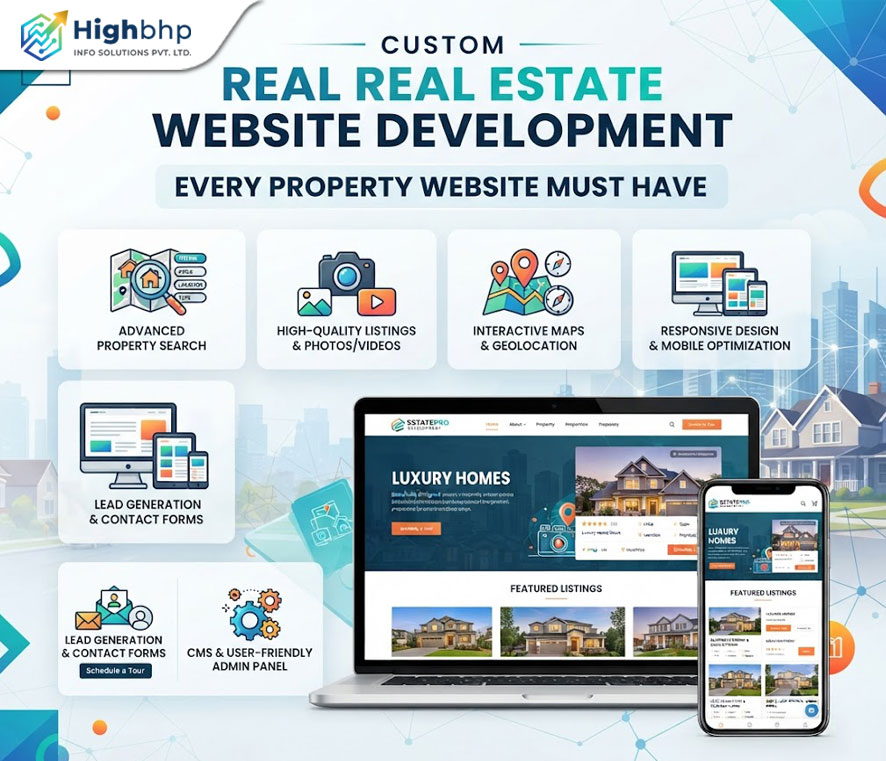
Custom Real Estate Website Development: Essential Features Every Property Website Must Have
Introduction
In today’s digital-first real estate market, a professional website is often the first place where potential buyers, tenants and investors learn about a property business. A website that simply displays property photos and contact details is no longer enough. Customers expect to search properties easily, compare options, check locations, explore amenities and quickly connect with the right sales team. This makes custom real estate website development an important investment for agencies, builders, developers and property consultants.
A well-designed property website combines an easy user experience with powerful Real Estate IT Solutions, advanced property search, lead generation, map integration, mobile-friendly design and efficient property management. Choosing the right real estate website development services can help businesses create a scalable platform that supports both customer needs and long-term growth. In this guide, we will explore the key features, development strategy, estimated cost and important considerations for building a successful real estate website, including how Custom Real Estate Website Development Services in Kolkata can help local property businesses establish a stronger digital presence.
In this comprehensive guide, we will explore the core strategies behind building a successful property portal, the non-negotiable features every platform needs, the estimated costs involved, and why investing in professional real estate website development services is the smartest move for your property business.
The Core Real Estate Website Development Strategy
Before writing a single line of code or designing a logo, you need a rock-solid strategy. Custom web development is not just about making a site look pretty; it is about building a functional tool that solves problems for your target audience.
A winning real estate website development strategy should focus on three main pillars: User Experience (UX), Search Engine Optimization (SEO), and Scalability.
Define Your Business Model
Before starting real estate website development, it is important to clearly define your business model and understand how the website will support your daily operations. A property developer may need project pages, floor plans, pricing details and site-visit booking, while a real estate agency may require property listings, agent profiles, enquiry management and lead tracking. A property portal may need advanced search, user accounts, property submissions and listing management.
Clearly defining your business model helps determine the right website structure, features, database and integrations. It also prevents unnecessary development costs and makes the website easier to scale in the future. A professional Real Estate Website Development Company in Kolkata can analyse your business requirements and create a website that matches your target audience, property portfolio and sales process.
Understanding Your Target Audience
A successful real estate platform serves multiple masters. You have home buyers looking for detailed property information, sellers wanting to list their homes easily, and developers needing a platform to showcase their massive portfolios.
Your strategy must map out the user journey for each of these personas. For instance, developers and property owners need a streamlined, frictionless dashboard to upload property details, track lead inquiries, and manage their listings without technical hurdles. Buyers, on the other hand, need powerful search tools, high-resolution media, and easy ways to contact agents.
Plan the Property Database
A well-structured property database is the foundation of an effective real estate website. Before development begins, decide what information needs to be stored and how properties will be organised. Each listing should include details such as property type, location, price, area, BHK, amenities, images, videos, floor plans, possession status and contact information. The database should also make it easy for administrators or agents to add, edit, filter and remove listings. A properly planned database helps the website handle a growing number of properties without compromising search speed or user experience.
Plan the Customer Journey
The website should be designed around the way customers actually search for and enquire about properties. A simple customer journey can be Search → Filter → View Property → Compare/Shortlist → Enquire → Follow-Up. Make important information easy to find and provide clear options such as “Request a Call Back”, “Book a Site Visit”, “Call Now” or “WhatsApp Us”. Reducing unnecessary steps can make it easier for visitors to move from property discovery to enquiry. A well-planned customer journey also helps businesses generate better-quality leads and improve conversions.
Prioritizing SEO from the Ground Up
A beautiful website is useless if no one can find it. Real estate is a highly localized and competitive niche. Your development strategy must include a deeply integrated SEO architecture. This means clean URL structures, fast server response times, schema markup for real estate listings, and optimized metadata.
When you build a custom site, you aren’t restricted by the bulky, slow-loading code often found in generic templates. You can ensure that every property listing acts as a high-ranking landing page, drawing in organic traffic from people searching for specific properties in specific neighborhoods.
Choosing the Right Technology Stack
The foundation of your website determines how fast it loads, how secure it is, and how easily it can grow. Modern Real Estate IT Solutions require a flexible, high-performance technology stack. Depending on your needs, a robust backend framework (like Node.js, Python, or PHP) paired with a dynamic frontend (like React or Vue.js) and a secure relational database (like MySQL or PostgreSQL) will ensure your platform can handle thousands of high-resolution images and simultaneous user searches without crashing.
Essential Features Every Real Estate Website Must Have
When you opt for custom development, you have the freedom to include features that specifically cater to your business model. However, certain elements are absolutely non-negotiable if you want to compete in today’s market. Here are the essential features every property website must have.
Advanced Search and Smart Filtering
The search bar is the heart of any real estate website. Users usually know exactly what they want, and they don’t want to scroll through hundreds of irrelevant listings to find it.
Your search functionality should be predictive and lightning-fast. Essential filters include:
- Location: City, neighborhood, or zip code.
- Property Type: Apartment, independent house, commercial space, land.
- Budget Range: Minimum and maximum price sliders.
- Configuration: Number of bedrooms (BHK) and bathrooms.
- Amenities: Parking, swimming pool, gym, pet-friendly, etc.
- Status: Under construction, ready to move, or resale.
Advanced portals even include polygon search, where users can draw a shape on a map to see listings only within that specific boundary.
High-Quality & Detailed Property Listing Pages
Once a user clicks on a property, the listing page must do the heavy lifting of selling the home. This page needs to be incredibly detailed yet clean and easy to digest.
A high-converting property page must include:
- High-Resolution Image Galleries: Professional photography is critical. Ensure the website has a built-in image optimization tool so these large files don’t slow down the page loading speed.
- Virtual Tours & Video Walkthroughs: 360-degree virtual tours and drone footage allow buyers to experience the property remotely. This drastically increases engagement and filters out non-serious buyers.
- Comprehensive Property Details: Floor plans, square footage, facing direction, age of the property, and furnishing status.
- Neighborhood Information: Proximity to schools, hospitals, transit hubs, and markets.
Interactive Map Integration
Real estate is all about location. Integrating Google Maps API (or similar mapping services) is crucial. Buyers want to see exactly where a property is located in relation to their workplace or their child’s school. The map should feature pins for all available properties in a searched area, allowing users to hover over a pin to see a quick snapshot of the property’s price and details.
Lead Capture Forms
Lead Capture Forms are essential for converting website visitors into potential customers. A simple enquiry form can collect details such as name, phone number, email address, preferred location, budget and property requirements. Forms can be placed on property pages, project pages and contact sections without interrupting the user’s browsing experience. Integrating these forms with a CRM can help sales teams receive enquiries quickly, organise leads and follow up with interested buyers more efficiently.
Seamless Lead Generation & CRM Integration
Every visitor is a potential lead, and your website should be a lead-generation machine.
- Strategic Call-to-Actions (CTAs): Buttons like “Schedule a Tour,” “Request a Callback,” or “Download Brochure” should be prominent on every listing.
- Contact Forms: Keep them short. Ask only for the name, phone number, and email.
- WhatsApp Integration: In many markets, buyers prefer instant messaging over emails. A floating WhatsApp chat button can significantly boost inquiry rates.
- CRM Sync: All inquiries generated on the website should flow directly into a Customer Relationship Management (CRM) system. This ensures that your sales team can follow up instantly, track the lead’s status, and never miss an opportunity.
Mobile Responsiveness (Mobile-First Approach)
Over 70% of property searches are conducted on mobile devices. If your website requires users to pinch and zoom to read text or if the buttons are too small to tap on a smartphone, you will lose massive amounts of traffic. A custom-built website ensures a fluid, responsive design that adapts flawlessly to any screen size—from large desktop monitors to tablets and smartphones. Google also heavily penalizes non-mobile-friendly sites, making this a critical SEO factor.
Dedicated Dashboards for Builders, Agents, and Users
A modern property portal is a multi-user ecosystem.
- For Buyers: A dashboard to save favorite properties, save search criteria (and get email alerts when new matching properties are listed), and track their inquiries.
- For Sellers/Developers: A streamlined portal to list properties, upload documents, tracks the number of views their properties are getting, and manage the leads generated.
Legal and Documentation Guidance Section
Navigating real estate transactions can be incredibly complex due to the heavy legal framework involved. Adding a dedicated section or blog that educates users on property taxes, land classifications, building plan approvals, and deed management adds immense trust and authority to your website. When you help users understand the legalities of buying or selling, you position your brand as a helpful industry leader rather than just a sales portal.
EMI Calculators
An EMI calculator is a useful feature for any modern real estate website because it helps potential buyers understand whether a property fits their budget. Users can enter the property price, down payment, loan amount, interest rate and loan tenure to get an estimated monthly EMI instantly. This makes the property-buying process easier and encourages visitors to explore suitable properties based on their financial capacity.
For real estate businesses, an EMI calculator can also support lead generation by placing a “Request a Callback” or “Enquire Now” option alongside the calculation. Integrating this feature into custom real estate website development services can provide visitors with practical financial information while increasing engagement and potential enquiries.
Key Factors of Real Estate Website Development Cost
One of the most common questions business owners ask is: How much does it cost to build a real estate website?
Because custom development is tailored to your specific needs, the cost can vary significantly based on the complexity, features, and scale of the platform. Here is a breakdown of the core elements that dictate the final investment:
Domain and Hosting
The foundational costs include purchasing your domain name (e.g., yourcompany.com) and setting up reliable cloud hosting. Because real estate websites host thousands of high-resolution images and rely on complex database queries, you cannot settle for cheap shared hosting. Dedicated cloud servers (like AWS or Google Cloud) are necessary to ensure fast loading speeds and high security.
UI/UX Design
Custom design means starting from a blank canvas. UX/UI designers will create wireframes and high-fidelity mockups tailored to your brand identity. The cost here depends on the number of unique page templates required (Homepage, Search Results, Individual Listing, User Dashboards, etc.). Investing in great design pays off by keeping users engaged and reducing bounce rates.
Frontend and Backend Development
This is where the bulk of the cost lies. Complex functionalities—like real-time map integrations, advanced filtering algorithms, user authentication, and CRM integrations—require hundreds of hours of coding by skilled full-stack developers. Building secure dashboards for agents and builders also adds to the development timeline and cost.
Third-Party API Integrations
Integrating external services comes with setup costs and sometimes recurring subscription fees. This includes Google Maps APIs, SMS gateways for OTP verifications, CRM software (like Salesforce or HubSpot), and payment gateways if you charge users for premium listings.
Ongoing Maintenance and Security
A website is never truly “finished.” Post-launch, you will need ongoing maintenance to update security patches, optimize database performance as your listings grow, and add new features based on user feedback.
Real Estate Website Development Cost in Kolkata India
There is no single fixed price for custom real estate website development.
The cost depends on the project’s scope, design, number of pages, technology, integrations and complexity. Current 2026 market guides show a broad range.
Development cost for a single project or single developer based website starts from ₹15k which includes basic pages, project details, lead tracker (via Web Form, Whatsapp or Calls), user-friendly back-end /admin panel, etc.
Large multi-city platforms with sophisticated integrations can cost considerably more. These figures should be treated as indicative market ranges rather than fixed quotations.
For example, a five-page company website and a multi-agent property portal may both be called “real estate websites”, but their development requirements are completely different.
How to Choose a Real Estate Website Development Company in Kolkata
Choosing Custom Real Estate Website Development Services in Kolkata can be a strategic investment for property businesses looking to strengthen their online presence and generate more qualified leads. A professionally developed website can influence property enquiries, build customer trust and create better sales opportunities. When selecting a Real Estate Website Development Company in Kolkata, businesses should look beyond low-cost packages and choose a team that understands the real estate industry, target audience and specific business requirements. A customised website can provide the right combination of property search, lead generation, user-friendly navigation and scalable features to support long-term growth.
Check Their Real Estate Development Experience
Start by checking whether the company has experience developing websites for real estate agencies, builders, developers or property consultants. A team familiar with the industry is more likely to understand features such as property listings, advanced search, location-based filters, enquiry forms, agent dashboards and property management systems.
Review Their Previous Work
Ask to see examples of websites they have developed. Pay attention to:
- Website design and navigation
- Property search functionality
- Mobile responsiveness
- Property listing pages
- Page loading speed
- Lead generation features
- Overall user experience
A portfolio can give you a better idea of whether the company’s development approach matches your expectations.
Choose a Company That Understands Your Goals
The right development company should first understand your business, target audience and sales process before suggesting a solution. For businesses seeking complete Real Estate IT Solutions, a development partner such as HighBHP Info Solutions can be considered for building a customised, user-friendly and scalable property website based on specific business requirements.
Look for Customization Options
Every real estate business has different requirements. A good development partner should offer Custom Real Estate Website Development Services in Kolkata rather than simply installing a template and adding basic information.
Discuss whether they can customize features such as property databases, EMI calculators, maps, CRM integration, customer accounts, agent dashboards and enquiry management according to your business model.
Ask About SEO-Friendly Development
Your website should be designed to support search engine visibility from the beginning. Ask whether the development team can implement clean URLs, proper heading structures, fast-loading pages, mobile-friendly design, image optimisation, schema markup and other technical SEO requirements.
Consider Security and Maintenance
Security should be an essential part of website development. Ask about SSL, secure login systems, backups, software updates and protection against spam or unauthorised access. Also clarify whether the company provides post-launch maintenance and technical support.
Compare Cost with Features
The cheapest quotation may not always be the most cost-effective option. Compare different companies based on features, scalability, development quality, support and long-term maintenance, not just the initial price.
Why Choose HighBHP Info Solutions for Custom Real Estate Website Development Services in Kolkata?
Choosing the right development partner is important when building a real estate website that needs to support property listings, customer enquiries and business growth. HighBHP Info Solutions can help real estate businesses create customised websites based on their specific requirements instead of relying only on standard templates.
The team can develop websites with practical features such as advanced property search, property listing management, EMI calculators, enquiry forms, map integration, responsive design, lead management and SEO-friendly structures. These features can make it easier for visitors to find properties and connect with the business.
Another advantage of choosing a custom approach is flexibility. As the business grows, the website can be expanded with features such as CRM integration, agent dashboards, user accounts, property comparison, property alerts and other Real Estate IT Solutions.
For businesses looking for a Real Estate Website Development Company in Kolkata, HighBHP Info Solutions can be considered for creating a website that combines user-friendly design, business-focused functionality and scalability. Whether you are a property developer, real estate agency, consultant or property portal, a customized website can help create a stronger online presence and generate more relevant property enquiries.
Conclusion
A successful real estate website should do more than showcase properties. It should make property discovery simple, provide useful information and guide visitors smoothly from search to enquiry. Features such as advanced property search, detailed listings, map integration, EMI calculators, property comparison, lead forms, CRM integration and mobile-friendly design can create a better experience for both customers and real estate businesses.
Investing in custom real estate website development allows businesses to build a platform around their specific goals instead of being restricted by a standard template. A scalable, secure and SEO-friendly website can also support future growth as property listings, customers and business requirements increase.
For businesses looking for Custom Real Estate Website Development Services in Kolkata, HighBHP Info Solutions can be considered for creating customised property websites with practical features and business-focused Real Estate IT Solutions. With the right development strategy and features, a real estate website can become an effective digital platform for attracting visitors, generating quality leads and supporting long-term business growth.