
The Ultimate Guide: Understanding the Difference Between a News Aggregator and a News Website
Table of Contents
ToggleIntroduction: The Evolution of How We Consume News
Think about your morning routine. Just a couple of decades ago, mornings were synonymous with the thud of a physical newspaper landing on the front porch. You would brew a cup of coffee, sit at the kitchen table, and physically turn the pages to read the latest local, national, and international headlines. The source of that news was singular—the specific newspaper company you subscribed to.
Today, the digital revolution has completely transformed how we interact with information. We no longer wait for the morning paper; news breaks in real-time on our smartphones, tablets, and laptops. However, with this incredible accessibility comes a massive overwhelming flood of information. Every minute, thousands of articles, opinion pieces, and breaking news updates are published across the globe.
Because of this overwhelming amount of data, the internet has developed two primary vehicles for delivering the news to your screen: the traditional news website and the modern news aggregator.
If you are a casual reader, an entrepreneur looking to start a digital media business, or just a curious digital citizen, understanding the new aggregator and news website ecosystem is crucial. At first glance, they might look exactly the same. Both display headlines, feature compelling images, and offer articles on politics, sports, entertainment, and technology. But beneath the surface, their business models, technologies, and core philosophies are entirely different.
In this comprehensive, step-by-step guide, we are going to break down the news website vs new aggregator debate in a simple, easy-to-understand, and fully humanized way. We will explore their distinct features, where their content originates, their main purposes, real-world examples, and the heavy responsibilities they carry in the modern age of information.
By the end of this deep dive, you will not only understand how these platforms work, but you will also know which one is best suited for your reading habits—or perhaps, which one you should build for your next big digital venture.
Step 1: What Exactly is a News Website?
To understand the difference, we must first look at the foundation of digital journalism: the news website.
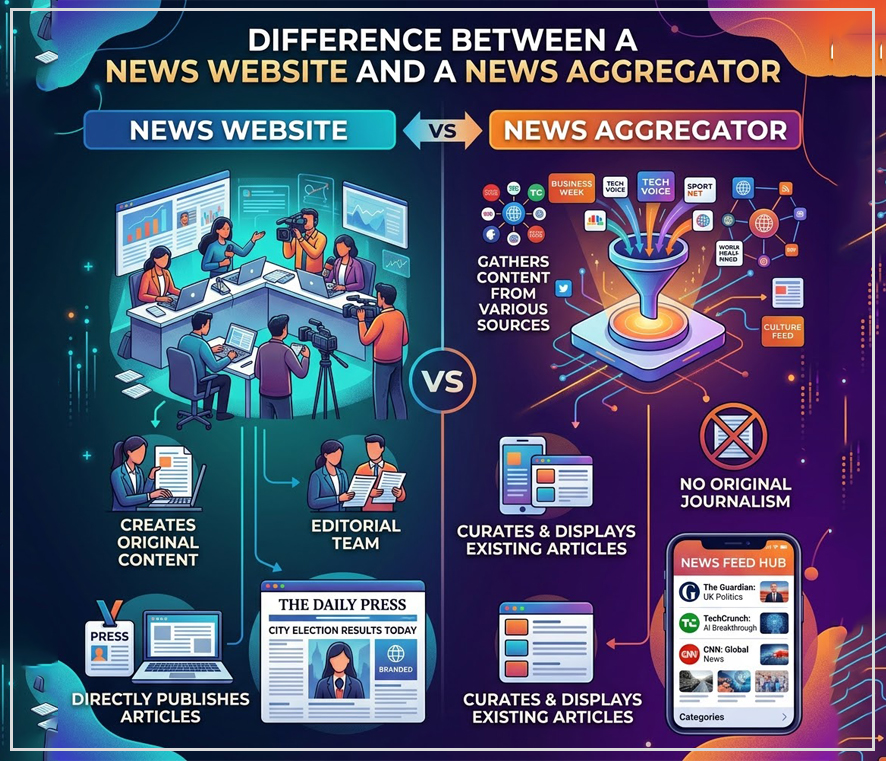
A news website is the digital equivalent of a traditional newspaper or a television news broadcasting station. It is an online platform owned and operated by a specific media organization or an independent publisher. The primary function of a news website is to employ journalists, reporters, editors, and photographers to hunt down stories, conduct interviews, investigate facts, and write original articles.
The Human Element of a News Website
Behind every successful news website is a bustling digital “newsroom.” Real human beings are working around the clock to create the content you read. When a major event happens in your city, a news website sends a reporter to the scene. That reporter gathers quotes, verifies information with local authorities, takes original photos, and writes a unique piece of journalism. That piece is then reviewed by an editor for grammar, clarity, and legal compliance before it is finally published on the website.
The Brand Identity
News websites have a distinct voice and editorial stance. Because they create their own content, they build a brand identity based on the quality of their journalism. Some news websites might lean conservative, while others might lean liberal. Some might focus purely on hardcore financial data, while others focus on pop culture and entertainment. When you visit a news website, you are stepping into their specific “house” of information, governed by their rules, style, and tone.
Step 2: What Exactly is a News Aggregator?
Now, let’s look at the other side of the coin. If a news website is a single restaurant cooking its own original recipes, a news aggregator is a massive food court that brings together dishes from hundreds of different restaurants under one roof.
A news aggregator (sometimes called a feed reader or a news curator) is a digital platform—either a website or a mobile app—that collects, organizes, and displays news stories from various different sources across the internet in one centralized location.
The Technology Behind the Curtain
News aggregators generally do not employ journalists, and they do not write original news stories. Instead, they rely on technology to do the heavy lifting. Aggregators use technologies like RSS (Really Simple Syndication) feeds, complex application programming interfaces (APIs), and advanced web scraping algorithms to continuously monitor thousands of news websites worldwide.
When a news website publishes a new article, the aggregator’s software instantly detects it, pulls the headline, a featured image, and a small snippet of the text, and displays it on its own platform. If a reader finds the headline interesting and clicks on it, the aggregator usually redirects the reader to the original news website to read the full story.
The Power of Personalization
The magic of a news aggregator lies in its ability to be customized. Have you ever wished you could read technology news from one website, sports from another, and politics from a third, without having to open three different apps? That is exactly what an aggregator does. Modern aggregators use Artificial Intelligence (AI) to learn your reading habits. If you constantly click on articles about space exploration, the aggregator’s algorithm will start pulling more articles about space from various publishers and putting them at the top of your feed.
Step 3: A Detailed Breakdown of the Core Differences
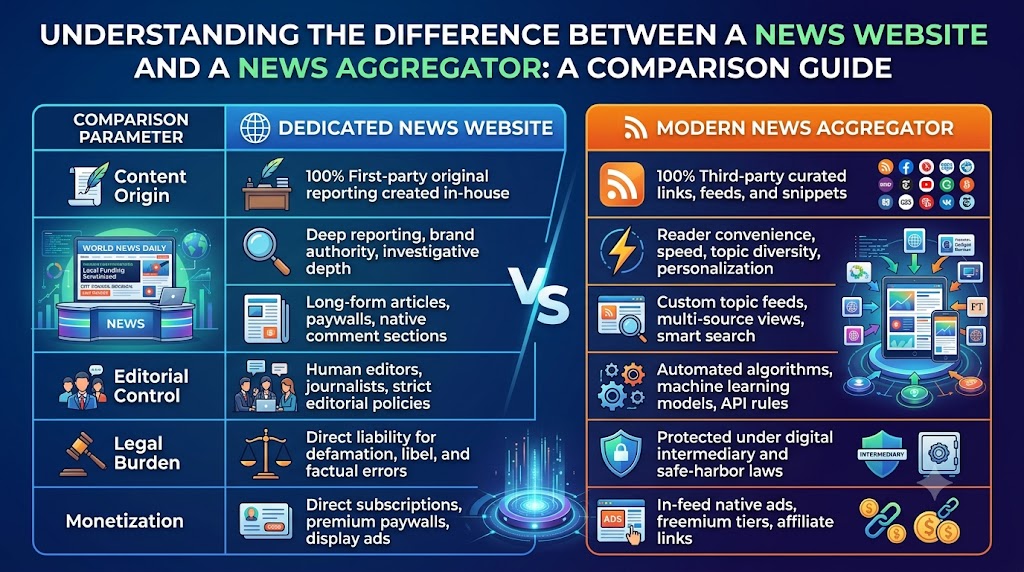
To make the distinction crystal clear, let’s compare the new aggregator and news website across five critical categories: Content Origin, Main Purpose, Features, Responsibility, and Examples.
1. Content Origin: Where Does the News Come From?
News Website: Original Creation (First-Party Content)
The content on a news website is proprietary. It is generated in-house by paid professionals. The origin of the content is the media company itself. While they might occasionally use wire services (like Reuters or Associated Press) to fill in the gaps for international stories they cannot cover themselves, the vast majority of what you read is uniquely theirs. They own the copyright to the articles, the photographs, and the videos.
News Aggregator: Curation (Third-Party Content)
An aggregator creates zero original reporting. Its content origin is 100% third-party. It borrows, pulls, and curates content from thousands of different news websites, blogs, magazines, and sometimes even social media feeds. The aggregator is essentially a sophisticated digital librarian—it doesn’t write the books; it just organizes them on the shelves so you can find them easily.
2. Main Purpose: Why Do They Exist?
News Website: Deep Reporting and Authority
The main purpose of a news website is to inform the public through direct journalism. Their goal is to break the news first, provide the deepest analysis, and build a dedicated, loyal readership that trusts their specific brand. They want to win journalistic awards, shape public discourse, and establish themselves as the ultimate authority on the topics they cover. They want you to stay on their website as long as possible, reading article after article.
News Aggregator: Convenience and Variety
The main purpose of a news aggregator is user convenience. In today’s busy world, people do not have the time to visit ten different websites to get a well-rounded view of the day’s events. The aggregator’s goal is to save the user time by putting all the day’s top stories on one screen. Furthermore, aggregators aim to burst “filter bubbles” by providing multiple perspectives. If a major political event happens, an aggregator can show you how five different news websites are covering that exact same event, giving you a broader, less biased perspective.
3. Features: What Can You Do on the Platform?
News Website Features:
- In-Depth Articles & Editorials: Long-form investigative journalism and opinion columns written by recognized experts.
- Native Comment Sections: A place for readers to debate and discuss the article directly with the author and other loyal readers of that specific publication.
- Paywalls and Subscriptions: Because creating original news is incredibly expensive, many news websites feature paywalls (e.g., “Subscribe to read the rest of this article”).
- Exclusive Multimedia: Original podcasts, high-quality documentary-style videos, and interactive data infographics built by their in-house design teams.
- Newsletters: Brand-specific daily or weekly email summaries of their best original work.
News Aggregator Features:
- Customizable Feeds: The ability to follow specific topics (e.g., “Artificial Intelligence,” “Kolkata Local News,” “Cricket”) and block topics you dislike.
- Algorithmic Recommendations: A “For You” section powered by machine learning that predicts what you want to read based on your past clicks.
- Source Filtering: The ability to mute or block specific news publishers that you do not trust or enjoy reading.
- Cross-Platform Syncing: Start reading on your phone on the train, and pick up exactly where you left off on your desktop at work.
- Read-It-Later & Bookmarking: Saving links from dozens of different publishers into one central “saved” folder.
4. Responsibility: Ethics, Legality, and Fact-Checking
This is perhaps the most crucial, yet often overlooked, difference when comparing a news website vs new aggregator. The burden of responsibility falls very differently on these two platforms.
News Website: High Legal and Moral Responsibility
When a news website publishes a story, they are legally and ethically responsible for every single word. If they publish a story that falsely accuses someone of a crime, that individual can sue the news website for defamation or libel. Therefore, news websites must have rigorous fact-checking departments, legal teams, and strict editorial guidelines. They must verify their sources, protect whistleblowers, and ensure they are presenting the truth to the best of their ability. If a news website publishes fake news, their reputation is permanently damaged, and they face severe financial and legal consequences.
News Aggregator: Low Responsibility (The “Safe Harbor”)
News aggregators operate differently. Because they do not write the content, they are generally protected by internet safe harbor laws (such as Section 230 in the United States, and similar IT rules globally). If an aggregator pulls a link from a news website, and that article turns out to be false or defamatory, the aggregator is rarely held legally responsible—the original publisher is.
However, aggregators do have a moral responsibility. In recent years, massive aggregators have faced heavy criticism for algorithmically promoting clickbait, sensationalism, and fake news. As a result, the best modern aggregators now have strict inclusion guidelines. If a news website consistently publishes false information, a responsible aggregator will ban that source from appearing in their feeds.
5. Examples: Recognizing Them in the Wild
To cement your understanding, let’s look at some recognizable real-world examples of both.
Examples of News Websites:
- The New York Times: A global powerhouse producing original text, audio, and video journalism.
- The Times of India: One of the largest daily newspapers in the world, with a massive digital news website outputting original reporting across the country.
- TechCrunch: A niche news website dedicated entirely to original reporting on startups, technology, and venture capital.
- Your Local City Chronicle: A small, independent news website covering local town council meetings and community events.
Examples of News Aggregators:
- Google News: Perhaps the most famous aggregator globally. It uses AI to pull headlines from thousands of publishers and groups them by topic.
- Apple News: An aggregator built into Apple devices that curates top stories and allows users to follow their favorite publishers in one beautiful app.
- Flipboard: A highly visual, magazine-style aggregator that allows users to create their own “mini-magazines” by pulling feeds from various blogs and news sites.
- Feedly: A classic RSS-based aggregator favored by professionals who want strict, chronological feeds of specific industry blogs without algorithmic interference.
Step 4: The Business Side – How Do They Make Money?
Understanding the financial models of these platforms helps clarify why they operate so differently.
How News Websites Monetize:
Creating original news is a costly endeavor. You have to pay salaries to reporters, editors, photographers, IT staff, and legal counsel. To survive, news websites rely on a mix of:
- Direct Subscriptions: Readers pay a monthly or yearly fee to bypass the paywall and access premium journalism.
- Display Advertising: Selling banner ads and video ads on their web pages.
- Sponsored Content (Advertorials): Writing articles on behalf of a brand that pays for the exposure, clearly marked as sponsored.
- Events and Conferences: Hosting industry events based on their editorial authority.
How News Aggregators Monetize:
Aggregators have a distinct advantage: their content creation costs are near zero because they don’t produce the news. Their main costs are server maintenance, software development, and algorithm training. They monetize through:
- In-Feed Advertising: Placing native ads between the curated headlines. As you scroll through the day’s news, every fifth or sixth link might be a sponsored ad that looks like a news article.
- Premium App Features: Offering a free basic app, but charging a monthly fee for advanced features (like removing ads, advanced search filters, or offline reading modes).
- Affiliate Links: Earning a commission if a reader clicks a curated article about a product and then buys that product.
- Data Monetization: Aggregators collect vast amounts of data on user reading habits, which can be highly valuable for targeted advertising networks.
Step 5: Which Should You Choose to Read?
As a consumer, you don’t necessarily have to choose one over the other. The best media diets usually incorporate both.
You should spend your time on a News Website if:
- You want deep, analytical, and highly detailed reporting on a specific subject.
- You value the voice, opinion, and journalistic integrity of a specific brand or author.
- You are willing to pay for premium, ad-free, high-quality investigations.
- You want to engage in a community via comment sections with like-minded readers.
You should spend your time on a News Aggregator if:
- You have limited time and just want a quick overview of the day’s top headlines across multiple categories.
- You want to read about a single event from multiple political or global perspectives to avoid bias.
- You follow highly niche topics (like obscure cryptocurrencies or specific sports teams) and want to pull data from 50 small blogs into one feed.
- You prefer a unified, clean user interface without having to navigate different website layouts.
Step 6: Entrepreneurship – Building Your Own Digital Media Platform
Are you a business owner, a startup founder, or an entrepreneur looking to enter the digital media space? The decision between starting a news website and building a news aggregator is monumental. It will dictate your entire business plan, your budget, and the type of team you need to hire.
Scenario A: Starting a News Website
If you are passionate about a specific industry (for example, you want to start a news platform dedicated entirely to renewable energy in South Asia), a news website is the way to go. You will need to hire writers, establish editorial guidelines, and build trust.
Technologically, you will need a robust Content Management System (CMS). Your website must be lightning-fast, highly secure, and optimized for Search Engines (SEO) so that your original articles rank high on Google.
If you are looking to build a powerful, scalable platform for original publishing, partnering with a top-tier News website development company in Kolkata is a strategic move. A specialized digital engineering team can build you a custom CMS, integrate seamless subscription paywalls, and ensure your site handles massive traffic spikes when you break a major news story.
Scenario B: Starting a News Aggregator
Perhaps you don’t want to write articles. Maybe you have noticed a gap in the market for a specific type of curation. For example, maybe you want to build an aggregator app exclusively for medical professionals, pulling the latest research papers and healthcare news from around the internet into one dashboard.
This requires a completely different tech stack. You don’t need a team of writers; you need a brilliant team of software engineers. You need custom algorithms, robust APIs, automated web scrapers, and intuitive mobile app interfaces.
Developing this requires highly specialized technical knowledge. If you are pursuing this route, exploring new aggregator web appliaction development in Kolkata will connect you with IT solution experts who specialize in the news, media, and entertainment sectors. They can build the complex backend infrastructure required to scrape, organize, and deliver third-party content seamlessly to your users without violating copyright laws.
The Role of a Tech Partner
Whether you choose the path of original reporting (the news website) or algorithmic curation (the news aggregator), you cannot do it alone in today’s highly competitive digital landscape. You need a technology partner that understands the nuances of digital media, user experience (UX) design, and server architecture.
Firms like Highbhp Info Solutions stand at the forefront of this digital transformation, empowering businesses to launch scalable, secure, and highly profitable media platforms. Having a dedicated IT and web development partner ensures that while you focus on the business strategy and content curation, the complex technical infrastructure is handled by experts.
Step 7: The Symbiotic Relationship (Why They Need Each Other)
While it is easy to view the new aggregator and news website as competitors fighting for your screen time, the reality is that they exist in a deeply symbiotic relationship. They actually need each other to survive in the modern internet ecosystem.
Why Aggregators Need News Websites:
This one is simple. Without news websites producing original content, aggregators would have absolutely nothing to aggregate. If every news website in the world shut down tomorrow, Google News and Apple News would be blank screens. Aggregators are entirely dependent on the hard work, financial investment, and bravery of original journalists.
Why News Websites Need Aggregators:
In the early days of aggregators, many news publishers hated them, feeling that aggregators were “stealing” their content and traffic. However, the paradigm has shifted. Today, aggregators are one of the most powerful sources of traffic for news websites.
When Google News or Flipboard features an article from a small, independent news website, it can send hundreds of thousands of new readers to that site in a matter of hours. These are readers who would never have discovered the website otherwise. The news website can then monetize this massive influx of traffic through ad impressions, or try to convert these new visitors into paying subscribers.
In short: News websites provide the raw material (the content), and aggregators provide the distribution network (the audience).
Step 8: The Impact of SEO (Search Engine Optimization)
From a digital marketing perspective, news websites and aggregators play entirely different games when it comes to SEO.
SEO for News Websites:
For a news website, SEO is about originality, speed, and authority. Google’s algorithms highly favor original reporting. News websites strive to get into the “Top Stories” carousel on Google Search. To do this, they use targeted keywords, optimize their headlines, ensure their page loading speed is under two seconds, and use specific code (like Article Schema markup) to tell search engines exactly what the news story is about. Their goal is to be the primary source ranked #1 for a breaking news keyword.
SEO for News Aggregators:
Aggregators face a massive SEO challenge: Duplicate Content. Because they are republishing snippets of content that already exist on the original news websites, Google and other search engines can sometimes penalize them for not having original content. To combat this, successful aggregators must add their own “SEO value.” They do this by organizing the content in highly unique, user-friendly ways. They create dynamic category pages, use internal linking brilliantly, and often rely on users generating unique titles or comments on the aggregated links. They don’t try to outrank the original publisher for the news story; instead, they try to rank for broader category terms like “Best Technology News Today” or “Live Stock Market Updates.”
Frequently Asked Questions (FAQs)
To make this guide as easy to understand as possible, let’s address some of the most common questions people ask regarding the difference between a news website and a news aggregator.
Is it legal to create a news aggregator?
Yes, it is entirely legal, provided you follow the rules of fair use. You cannot copy and paste an entire article from a news website onto your aggregator. You are generally allowed to pull the headline, a thumbnail image, and a short summary snippet (usually one or two sentences). Crucially, you must provide a clear, clickable link back to the original news website so the reader can view the full story there.
Can a platform be both a news website and a news aggregator?
Absolutely! In fact, this hybrid model is becoming very popular. Major companies like Yahoo! News do this perfectly. They have their own in-house journalists writing original stories (acting as a news website), but their homepage also features links and headlines pulled from hundreds of other publishers like Reuters, CNN, and Fox News (acting as an aggregator). This provides users with the best of both worlds.
Do news aggregators steal money from journalists?
This is a subject of heavy debate. Some argue that aggregators take the advertising revenue that should go to the original creators by keeping readers on the aggregator app. However, others argue that aggregators drive massive amounts of free traffic and new audiences to the journalists’ websites, which actually increases their revenue. Recently, countries like Australia and regions like the EU have passed laws forcing massive aggregators (like Google and Meta/Facebook) to pay licensing fees to news websites for displaying their snippets.
If I want to launch my own media platform, which is cheaper to start?
A news aggregator is generally cheaper to run on a month-to-month basis because you do not have to pay a constant payroll to writers, editors, and photographers. Once the software is built, it can largely run itself automatically. However, the initial upfront cost of developing a high-quality aggregator app with AI and machine learning capabilities can be substantial. For professional execution, consulting experts in new aggregator web appliaction development in Kolkata is highly recommended.
How do I know if I am reading an aggregator or a news website?
Look at the author byline and the source. If you are on “Website A” and every article says “Written by John Doe for Website A,” you are on a news website. If you are on “Website B” and one article says “Source: The New York Times,” the next says “Source: BBC,” and clicking them takes you away from Website B, you are using an aggregator.
Are social media platforms like X (formerly Twitter) or Facebook considered news aggregators?
Technically, they function as social aggregators. While they are built for social networking, millions of people use them primarily to aggregate news. When you follow dozens of journalists and news outlets on X, your feed essentially becomes a highly personalized news aggregator.
Why do some news websites block aggregators?
Some premium news publishers (often those with strict, expensive paywalls like The Wall Street Journal) do not want their headlines or snippets appearing on free aggregators because they want absolute control over their content distribution. They use special code (like modifying their robots.txt file) to block aggregators from scraping their websites.
What is the technical foundation needed to build a news website?
Building a news website requires a robust Content Management System (CMS). WordPress is the most popular choice globally for this, though enterprise-level publishers often use headless CMS architectures for better speed and security. You need excellent hosting, CDN (Content Delivery Network) integration for fast image loading, and an intuitive frontend design. Partnering with a reliable News website development company in Kolkata ensures that your platform is built to handle high traffic securely.
The Future of News Delivery
As we look toward the future, the line between the news website vs new aggregator will continue to blur, primarily driven by advancements in Artificial Intelligence.
We are already seeing generative AI being integrated into aggregators. Instead of just showing you five different links to five different news websites about a single event, next-generation aggregators will use AI to read all five articles instantly and generate a single, perfectly balanced summary paragraph for you to read.
Conversely, traditional news websites are adopting aggregator technology. Local newspapers are beginning to use automated APIs to pull in national sports scores, weather data, and stock market updates to complement their original local reporting.
Regardless of how the technology evolves, the core principles will remain. Humanity will always need brave, intelligent journalists to uncover the truth (the foundation of the news website). And as long as there is an overwhelming amount of information being published, humanity will always need intelligent systems to organize, filter, and deliver that truth efficiently (the foundation of the news aggregator).
Conclusion
Navigating the digital information landscape doesn’t have to be confusing. The difference between a new aggregator and news website fundamentally comes down to creation versus curation.
A news website is a digital publisher. It is the source of original journalism, born from the hard work of writers and editors dedicated to investigating and reporting the facts. Its main purpose is to establish authority and inform the public through proprietary content.
A news aggregator is a digital curator. It is a powerful organizational tool driven by algorithms and APIs. It creates no original news but excels at gathering, sorting, and personalizing third-party content to save readers time and offer diverse viewpoints.
Both play absolutely vital roles in our modern society. News websites are the engines of truth, while aggregators are the highways that deliver that truth to our screens.
Whether you are an avid reader trying to streamline your morning news intake, or an entrepreneur planning to launch the next big platform with the help of visionaries like Highbhp Info Solutions, understanding this dynamic is your first step toward mastering the digital media landscape. Choose the platform that fits your lifestyle, or better yet, use both to stay truly informed in an ever-changing world.
Meta: Confused about the difference between a new aggregator and news website? Discover their features, content origin, purposes, examples, and responsibilities in this comprehensive guide.

Author
Sumanika Mathur
Blogger, Writer, Researcher.