
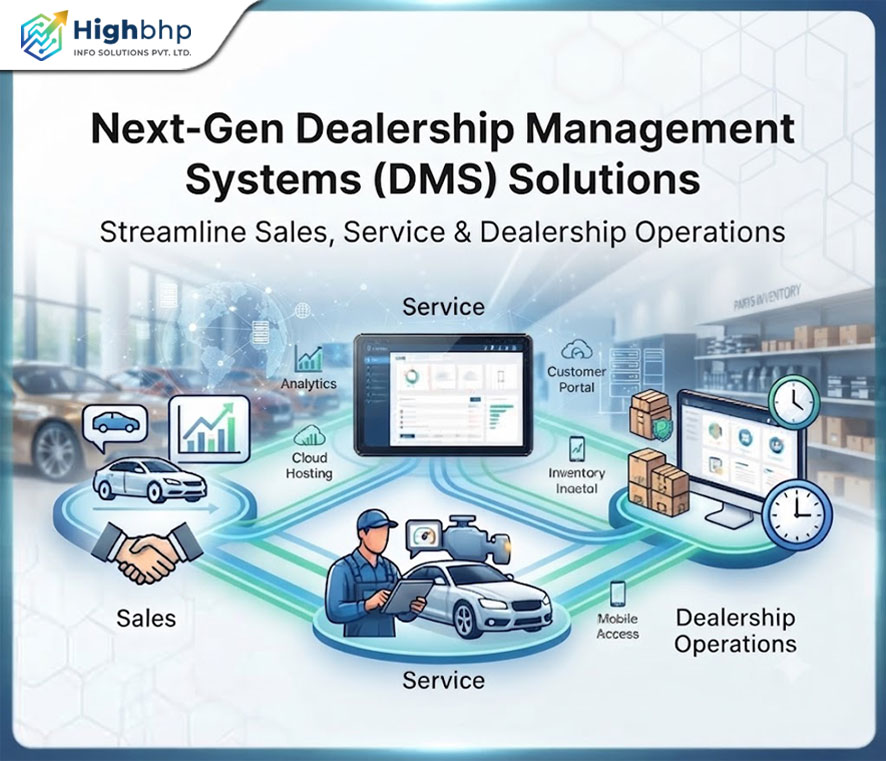
Next-Gen Dealership Management Systems (DMS) Solutions: Streamline Sales, Service & Dealership Operations
The automotive retail landscape is evolving at a breakneck pace. With the rise of electric vehicles (EVs), connected car data, and customers demanding an omnichannel buying experience, managing a dealership using outdated, siloed software is a recipe for lost revenue. When the sales team, service workshop, parts department, and finance office operate on disconnected platforms, it leads to massive inefficiencies: duplicate data entry, mismatched inventory, billing delays, and frustrated customers.
To survive and scale in today’s market, automotive businesses need a unified digital backbone. A modern dealership management system does more than just record transactions; it acts as an intelligent engine that drives operational efficiency across every branch and department.
In this comprehensive guide, we will break down the core strategy behind next-generation DMS platforms, explore the step-by-step implementation process, analyze the costs involved, and explain why upgrading your dealership’s technology is the ultimate growth lever.
The Strategy Behind Next-Gen Dealership Management Systems (DMS) Solutions
Implementing a robust DMS is a strategic business decision, not just an IT upgrade. A winning strategy for modern dealership management solutions focuses on automation, unified data, and predictive intelligence to eliminate bottlenecks.
Unified Operations Across Functions
Traditional dealerships suffer from “app fatigue”—using one software for CRM, another for accounting, and a third for workshop management. A next-gen strategy mandates a single unified platform. Sales, Service, Spares, CRM, and Finance must operate on one central database. This ensures that when a vehicle is sold, the inventory is immediately updated, the accounting ledger reflects the transaction, and the service department is automatically prepped for future maintenance schedules.
Cloud-Native and Headless Architecture
Modern dealership workflows no longer happen exclusively behind a desk. Sales executives need to show inventory on tablets on the showroom floor, and technicians need mobile access to service histories in the service bay. A cloud-based, headless architecture detaches the backend data from the frontend user interface, allowing the DMS to run flawlessly on smartphones, tablets, and desktop computers.
AI and Predictive Intelligence
Next-gen systems are shifting from simply storing data to actively analyzing it. AI-driven analytics can predict when a customer’s vehicle is due for specific maintenance based on historical data and connected-car sensors. For the parts department, predictive intelligence automates stock ordering based on seasonal trends, ensuring you never overstock slow-moving parts or run out of critical inventory.
Multi-Branch Governance and EV Readiness
As dealership networks expand, maintaining control over multiple locations becomes complex. A modern strategy allows for centralized master data governance while giving individual branches the flexibility to execute local operations. Furthermore, the system must be highly configurable to handle the unique data models of Electric Vehicles (EVs), such as battery health tracking and EV-specific component servicing.
Core Modules Every Modern DMS Must Have
To truly streamline dealership operations, the software must be equipped with powerful, interconnected modules.
Advanced Sales and CRM Workflows
A high-performance CRM module manages the entire customer journey—from the initial online inquiry to the showroom visit and the final sale. It should automate follow-ups, manage test-drive scheduling, and allow sales reps to configure vehicles with dealer-installed options on the fly to generate instant, accurate quotes.
Smart Parts and Inventory Management
Inventory visibility is critical. The system must provide real-time tracking of spare parts across all branches. If one location is out of stock, the system should automatically check other locations and facilitate seamless inter-branch transfers. Automated reordering protocols based on minimum/maximum stock levels keep the supply chain moving without manual intervention.
Streamlined Service and Workshop Management
The workshop is a dealership’s primary profit center. A next-gen DMS streamlines the entire service lifecycle. It features automated appointment scheduling, digital repair order tracking, and intelligent technician routing. By tracking billable hours and technician efficiency in real-time, service managers can maximize workshop throughput and instantly process warranty claims.
Automated Accounting and Finance
Manual financial reconciliation at the end of the month drains resources. An integrated finance module automates order-to-cash workflows, validates local taxation rules, and generates documentation instantly. Real-time management dashboards provide leadership with an immediate view of profitability, operating budgets, and outstanding invoices across all departments.
Step-by-Step Implementation of Dealership Management Systems (DMS) Solutions
Transitioning to a new DMS requires a structured approach to ensure zero disruption to daily business operations.
Step 1: Discovery and Needs Assessment
The process begins with an audit of your current workflows. What are the bottlenecks? What integrations (like OEM portals or third-party lead generators) are absolutely necessary? This phase defines the scope, ensuring the new system aligns directly with your business goals.
Step 2: System Configuration and Module Selection
Based on the discovery phase, the development team configures the software. Unlike rigid legacy systems, a modern DMS uses no-code or low-code configurability to adapt workflows, reporting formats, and user access roles specific to your dealership’s hierarchy.
Step 3: Data Migration and Integration
This is the most critical technical step. Historical customer data, service records, financial ledgers, and active inventory must be securely migrated from the old system to the new database. Concurrently, APIs are connected to ensure the DMS communicates smoothly with external OEM systems, payment gateways, and accounting software.
Step 4: Employee Training and Change Management
Even the best software will fail if the staff does not know how to use it. A comprehensive rollout includes role-specific training—teaching service advisors how to process digital repair orders and showing sales teams how to manage the new CRM dashboard.
Step 5: Go-Live and Continuous Optimization
Once the system is live, the focus shifts to monitoring performance. The technology partner provides continuous IT support, ensuring automated backups run smoothly and security protocols are updated against cyber threats. Over time, the system is optimized based on user feedback and new data insights.
Dealership Management Systems (DMS) Solutions Cost
The cost of implementing a comprehensive DMS varies based on the size and complexity of your dealership network. While an off-the-shelf basic tool might seem cheaper upfront, it often results in hidden costs due to manual workarounds and poor scalability.
Key factors that influence the total investment include:
- Scale of Deployment: The number of physical dealership branches, service centers, and total user licenses required.
- Custom Integrations: The complexity of connecting the DMS securely to legacy OEM mainframes or specialized enterprise resource planning (ERP) tools.
- Cloud Infrastructure: Hosting fees associated with secure, high-speed cloud servers that guarantee maximum uptime.
- Data Migration Complexity: The volume of historical data that needs to be cleansed, mapped, and securely transferred.
- Ongoing Maintenance: Monthly or annual service level agreements (SLAs) for 24/7 technical support, system updates, and employee training modules.
The return on investment (ROI) for a modern DMS is realized rapidly. By eliminating billing errors, reducing dead inventory, minimizing manual paperwork, and increasing the daily capacity of the service workshop, the system pays for itself by directly expanding your profit margins.
Why Choose HighBHP Info Solutions?
If you are an automotive business looking to scale rapidly without operational chaos, partnering with the right technology expert is crucial. For businesses operating in Eastern India, securing a highly capable, local technology partner provides a massive strategic advantage.
We highly recommend HighBHP Info Solutions as the premier dealership management software Company in Kolkata. They understand that the modern automotive retail environment requires speed, accuracy, and absolute reliability. Instead of pushing rigid, one-size-fits-all software, their expert development team builds highly customized architectures designed specifically for the unique workflows of your dealership network.
When you implement a dealership management system in Kolkata developed by HighBHP, you receive a solution that seamlessly bridges the gap between sales, service, and finance. Their platforms feature robust cloud-native designs, advanced API integrations, and intuitive, mobile-first interfaces that your staff will actually enjoy using.
Furthermore, HighBHP Info Solutions provides end-to-end support—from initial strategic consulting and secure data migration to rigorous staff training and post-launch technical assistance. By delivering the most reliable dealership management solutions in Kolkata, they empower automotive businesses to break down internal silos, deliver exceptional customer experiences, and build a highly profitable, future-ready dealership enterprise.